
Chiropractor for Back Pain in Algonquin: Your Best Treatment Option
If you’re like 80% of Americans, you’ve already experienced back pain — or you will. Maybe it was a workplace injury. Maybe it came from a car accident, or you simply bent down to pick something up and heard a sound that changed your week. However it started, the pain is real, and you want real answers.
The good news: you don’t have to live with it, and you don’t have to rush into surgery or rely on medication to get through the day. For the majority of back pain patients, seeing a chiropractor for back pain is the most effective first step — and the research strongly agrees.

At Algonquin Chiropractic Center, we’ve helped thousands of patients across the Chicagoland area find lasting relief from chronic and acute back pain. Here’s everything you need to know about the condition, your options, and why chiropractic care consistently outperforms the alternatives.
→ Learn More About Our Back Pain Treatment in Algonquin, IL
How Serious Is Back Pain, Really?
When you’re suffering, it’s easy to feel like people around you don’t get it. And culturally, back pain is often dismissed as something to “push through.” But the data tells a very different story.
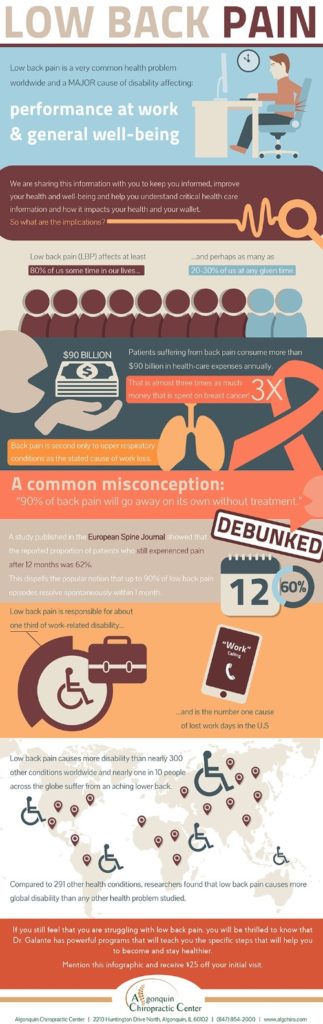
Lower back pain is the leading cause of disability worldwide, affecting nearly one in every ten people globally. Here in the United States:
- 31 million Americans suffer from back pain at any given time
- Back pain is the #1 cause of lost workdays, accounting for more than 264 million missed work days per year — roughly two full days for every working American
- It accounts for approximately one-third of all work-related disabilities
- Americans spend an estimated $87.6 to $100 billion per year treating back pain — more than is spent on diabetes management, and nearly three times what’s spent annually on breast cancer treatment
A widely-cited statistic claims that 90% of back pain resolves on its own within a month. Research published in the European Spine Journal disputes this directly: 62% of patients still reported pain after 12 months — and that figure climbed as high as 75% in some study populations.
The takeaway: back pain doesn’t usually just go away. Ignoring it puts you at greater risk of chronic pain and long-term disability. The sooner you seek the right kind of care, the better your outcomes will be.
What Causes Lower Back Pain?
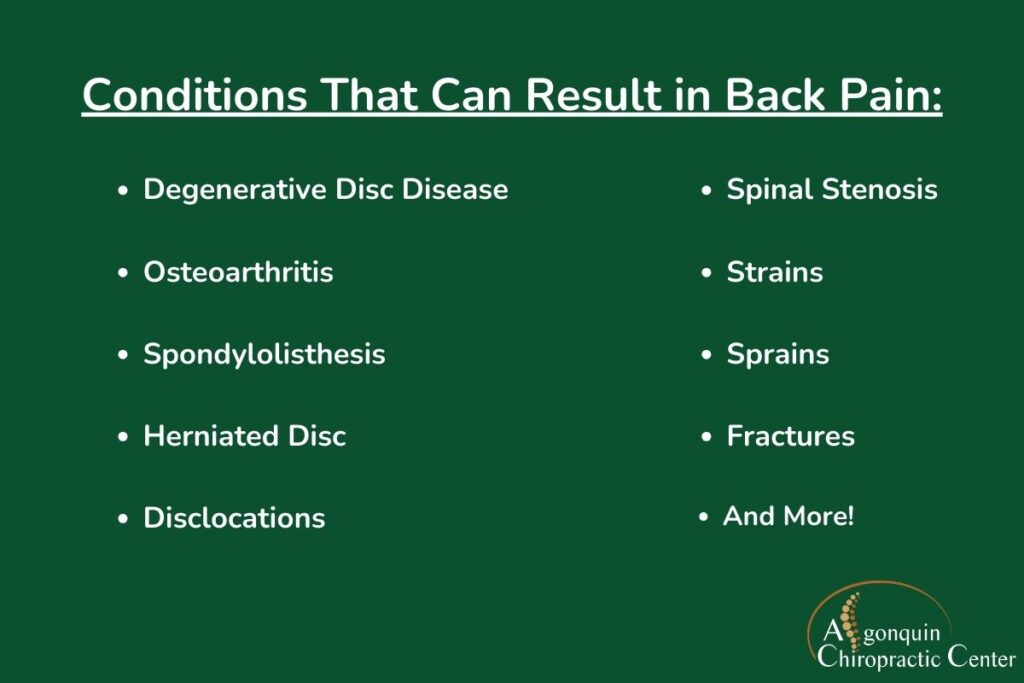
Technically, back pain is a symptom, not a condition. It’s the result of an underlying issue that — until identified and treated — will keep producing pain. Common causes include:
- Muscle strains and sprains — the most common cause; often from improper lifting, sudden movements, or prolonged poor posture
- Herniated or bulging discs — when the soft inner material of a spinal disc pushes out and irritates nearby nerves
- Degenerative disc disease (DDD) — gradual breakdown of the discs between vertebrae, common with age
- Spinal stenosis — narrowing of the spinal canal that puts pressure on nerves
- Sciatica — compression of the sciatic nerve, producing pain that can travel down the leg
- Spondylolisthesis — when a vertebra slips out of position
- Facet syndrome — irritation of the small stabilizing joints of the spine
- Osteoarthritis — cartilage breakdown in the spinal joints
- Fractures or dislocations — often from trauma, falls, or accidents
Other contributing factors include inactivity, being overweight, smoking (which significantly worsens pain), poor posture — particularly from prolonged desk work or phone use — and chronic muscle tension.
Some causes are traumatic and sudden. Others build quietly over years. Many patients genuinely don’t know what triggered their pain, which is completely normal. Our job at Algonquin Chiropractic Center is to find the underlying cause of your pain and treat that cause directly — not mask it with medication.
What Are Your Treatment Options for Back Pain?
Not all back pain treatments are created equal. The type of care you receive is largely determined by which provider you see first — so it’s worth understanding what each approach actually delivers.
Painkillers and Opioids
Drug-based approaches remain far too common as a first response to back pain. Opioids and other painkillers may reduce pain in the very short term, but they come with significant costs:
- They don’t address the root cause — they only mask symptoms
- The masking effect fades as tolerance builds
- They carry high addiction risk, as the opioid crisis has made painfully clear
- They often lead to a cycle of increased dosage with decreasing effectiveness
Research has found a 41% increase in painkiller use among patients who underwent back surgery — which tells you something important about the surgery itself, too.
Lumbar Epidural Steroid Injections (LESIs)
Many orthopedic doctors and pain management specialists prescribe steroid injections as a first or second line of treatment. LESIs can temporarily reduce inflammation, but they share the same fundamental problem: they don’t correct spinal biomechanics. Their long-term success rate as a stand-alone therapy is approximately 15%.
At Algonquin Chiropractic Center, we may incorporate LESIs as a supplemental tool when severe inflammation is getting in the way of other treatments — but never as the primary solution. Learn more about how lumbar epidural steroid injections fit into a comprehensive chiropractic plan.
Back Surgery
Surgery should be an absolute last resort for back pain — not a first option, and not even a second or third. The data on back surgery outcomes is sobering:
- Studies suggest that up to 70% of low back surgeries may have been unnecessary
- In one study, only 26% of patients who had back surgery returned to work within two years — compared to 67% of patients who did not have surgery
- That means you statistically have a 257% better chance of returning to work if you avoid surgery
- Post-surgical patients showed a 41% increase in opioid use, indicating the surgery often doesn’t resolve the underlying pain
The European Guidelines for the Management of Acute and Chronic Nonspecific Low Back Pain states clearly: “Surgery for non-specific chronic low back pain cannot be recommended unless two years of all other recommended conservative treatments — including multidisciplinary approaches with combined programs of cognitive intervention and exercises — have failed.”
Read more: Why Chiropractic Is a Better Option Than Low Back Surgery
Chiropractic Care
Chiropractic care addresses back pain the right way: by identifying and treating the root cause through non-invasive, drug-free methods grounded in spinal biomechanics.
The American College of Physicians (ACP) recommends noninvasive, non-drug treatments — including spinal manipulation — before drug therapies for back pain. The American Medical Association (AMA) published a review of 26 studies confirming that spinal manipulation therapy is effective for acute low back pain with minimal to no side effects.
Most of our patients see 50% improvement in pain within the first four weeks of treatment. Treatment plans typically run about 90 days, though severe cases may require longer.
How Chiropractic Care Treats Back Pain at Algonquin Chiropractic Center
Dr. Galante builds individualized treatment plans because no two backs — and no two patients — are the same. Depending on your diagnosis, your plan may include a combination of:
Cox Technic Flexion-Distraction
A gentle, non-force technique that decompresses the spine and is particularly effective for herniated discs, sciatica, and spinal stenosis. Dr. Galante holds a specialized Cox Technic certification.
Spinal Manipulation (Chiropractic Adjustments)
The core of chiropractic care — restoring proper alignment and motion to the vertebrae to relieve nerve pressure and reduce pain. Learn more about how chiropractic spine adjustments address back pain.
Spinal Decompression Therapy
A motorized traction technique that gently stretches the spine to take pressure off compressed discs and nerves. Learn more about spinal decompression treatment.
Laser Therapy
Low-level laser therapy accelerates cellular healing, reduces inflammation, and relieves pain without drugs or surgery.
Physical Therapy Modalities
Electrical muscle stimulation, ultrasound therapy, and therapeutic exercise to restore strength and flexibility.
Custom Orthotics
Improper foot mechanics can create a chain reaction of alignment issues that contribute to back pain. Custom orthotics address the problem at its foundation.
Corrective Exercises and Stretches
Home exercise programs — including specific stretches for lower back pain — extend the benefits of your in-office treatment and reduce the risk of re-injury.
Managing Back Pain at Home: Practical Tips That Actually Help
In-office treatment addresses the underlying cause of your pain. These strategies help you manage flare-ups and protect your back between visits.
Movement and Position
Avoid prolonged bed rest. It feels counterintuitive, but staying in bed weakens the muscles supporting your spine and typically makes pain worse. Gentle movement is almost always better.
Avoid prolonged sitting. Sitting puts pressure on the lumbar discs. If you work at a desk, get up and move for a few minutes every 30–45 minutes. Read more about how poor posture affects your back.
Use cold therapy. Apply a cold pack for 15 minutes every one to two hours during acute flare-ups. Ice packs, cold gel packs, or even a bag of frozen vegetables work well. Cold reduces inflammation and numbs acute pain more effectively than heat in the first 48–72 hours.
Sleeping Positions
How you sleep has a significant impact on your back:
- On your back: place a pillow under your knees to reduce lumbar pressure
- On your side: place a pillow between your knees to keep your spine in neutral alignment
- Avoid sleeping on your stomach — this hyperextends the lumbar spine and strains the neck
Transitions: Getting Up Without Making It Worse
One of Dr. Galante’s most-asked questions is: “How do I get up when my back is this bad?” Transitions — moving from lying down to sitting to standing — are when many patients aggravate their pain most.
Sitting to standing: Scoot to the front edge of your chair so your knees are just past your feet. Place your hands on the armrests (or your thighs if there are none) and push straight up — don’t lean forward or sideways, as that rotation is where pain spikes.
Lying down to standing: Roll to your side near the edge of the bed with knees slightly bent. Simultaneously swing your legs off the bed and push up with your top arm, letting your elbow brace you briefly before you fully sit up. From seated, follow the instructions above. Do not sit straight up from your back like a crunch — that movement is one of the fastest ways to spike acute low back pain.
Getting in and out of a car: Stand with your back to the seat. Lower yourself down so you’re seated with your legs still outside the car. Then rotate your whole body — legs together — to bring your feet inside. Reverse the process to exit. Avoid twisting your spine to get in or out.
Driving with Back Pain
- Experiment with your seat angle — a slightly reclined position often reduces lumbar pressure
- Move your seat forward an inch or two so your knees are slightly flexed; this can also relieve sciatic pain
- Place a small rolled towel or lumbar support in the curve of your lower back
Weight and Lifestyle
Carrying excess weight — particularly around the midsection — shifts your center of gravity forward and places chronic stress on the lumbar spine. Even modest weight loss can meaningfully reduce the mechanical load on your lower back. Read more about how weight management for back pain can be part of your treatment plan.
Frequently Asked Questions About Chiropractic Care for Back Pain
Is chiropractic care safe for back pain?
Yes. Chiropractic is one of the safest treatments available for back pain. The American Medical Association reviewed 26 studies confirming it is effective for acute low back pain with minimal to no side effects — far safer than surgery or long-term opioid use.
How many visits will I need?
Most patients begin feeling meaningful improvement within four weeks. Full treatment plans typically run approximately 90 days, though this varies based on the severity and underlying cause of your condition. Dr. Galante will outline a personalized timeline at your initial consultation.
Does insurance cover chiropractic care for back pain?
Most major insurance plans — including many Medicare and workers’ compensation plans — cover chiropractic care. Coverage details vary by plan. See our full guide to chiropractic insurance coverage, or call our office and we’ll help verify your benefits before your first visit.
What if I’ve already seen another doctor and tried other treatments?
That’s common, and it doesn’t disqualify you from chiropractic care. Many of our most successful patients come to us after months or years of trying other approaches. A thorough chiropractic exam may uncover the actual cause of your pain — something other providers may have missed.
Do I need an X-ray or MRI before my first appointment?
Not necessarily. Dr. Galante will perform a comprehensive examination and, if imaging is needed, will arrange it as part of your workup. Bring any existing imaging to your first visit.
What if my doctor says I need surgery?
Get a second opinion — preferably from a chiropractor. Research consistently shows that the vast majority of back surgeries are either unnecessary or no more effective than conservative care. A chiropractic evaluation gives you a full picture of your options before making an irreversible decision.
Ready to Find Real Relief? See a Chiropractor for Back Pain in Algonquin, IL
The research is clear. The outcomes data is clear. Chiropractic care is the most effective, safest, and most evidence-backed first-line treatment for the vast majority of back pain conditions — far outperforming surgery, opioids, and steroid injections for long-term results.
Dr. Anthony Galante at Algonquin Chiropractic Center has helped thousands of patients in the Algonquin, Lake in the Hills, Cary, and greater Chicagoland area find the lasting relief they thought was out of reach.
Your first step is a consultation. We’ll examine your spine, identify the root cause of your pain, and build a personalized treatment plan designed to get you back to your life.
📞 Call (847) 854-2000 to schedule your consultation today.
Or request an appointment online →
Serving Algonquin, Lake in the Hills, Cary, Crystal Lake, and the surrounding Chicagoland communities.